
Be Your Own Bank with DePix
“Be your own bank” has become a crypto slogan — and like most slogans, it’s widely misunderstood. It does not mean opening a financial institution, promising anyone returns, or dodging taxes. It means something simpler and more powerful: holding your money directly, moving it without asking permission, and keeping your transactions private when there’s no legitimate reason for them to be public.
One honest disclaimer up front: this is educational content, not investment advice, and does not constitute a recommendation to buy or sell any asset. The goal is to explain how self-custody works and what responsibilities it brings — so you can decide with clear eyes, not because of hype.
What “be your own bank” really means
When you keep money in a traditional bank, what you hold isn’t quite money — it’s a claim. The bank records that it owes you that amount, but it uses your balance to lend and invest. Most of the time this works fine. The trouble shows up in the exceptions: accounts frozen by mistake, withdrawal limits during a crisis, assets blocked by an arbitrary decision. These aren’t hypotheticals — they’ve happened, in Brazil and around the world.
To be your own bank flips that logic. With self-custody, your money doesn’t sit on someone else’s server: it lives under your cryptographic keys, on your own device. Three pillars hold the idea up:
- Direct ownership: the asset is yours, not a claim someone owes you.
- No gatekeeper: nobody has to approve your sends or receives. There’s no middleman who can say “no” and freeze your funds.
- Privacy: on the Liquid Network, transaction amounts are encrypted by Confidential Transactions¹ — only sender and receiver know how much moved.
This isn’t rebellion against the state. It’s the same instinct as locking your front door or keeping an emergency fund: having options instead of depending entirely on someone else’s goodwill. The theme ties directly into the idea of the sovereign individual and permissionless money .
The tools: DePix to spend, Bitcoin to save
Here’s the part that causes the most confusion — and where honesty matters most. Each tool solves a different problem. Using the wrong one for the wrong job is the fastest way to get frustrated.
DePix is a stablecoin on the Liquid Network where 1 DePix equals 1 Brazilian real. It was designed for private, sovereign everyday payments — spending, receiving, transacting. But let’s be blunt: DePix is not a store of value. It’s pegged to the real, and the real loses purchasing power to inflation over time. Holding DePix for years expecting it to “appreciate” is a mistake — it tracks the real, inflation and all. And like any stablecoin, the 1 DePix = 1 real parity depends on the issuer and its backing — it is not an automatic guarantee.
To store value for the long term, the asset is Bitcoin. Over the past two decades it has historically been regarded as one of the best stores of value: truly permissionless money that no government or institution controls³. L-BTC (Bitcoin on Liquid) inherits that sovereignty and adds superior privacy via Confidential Transactions. The trade-off has to be said: Liquid is operated by a federation, which makes it more centralized than Bitcoin’s main chain. And Bitcoin itself has a practical limitation for payments: its volatility — the price swings a lot, which makes it impractical for buying your morning coffee.
The rule of thumb is simple: use Bitcoin to save, use DePix to spend with privacy. Understanding this avoids the two most common errors — treating DePix as an investment, and trying to pay for groceries with a volatile asset.
The integrated wallet: self-custody without the headache
For a long time, “be your own bank” required technical knowledge that scared most people away. The DePix App fixed that with the integrated wallet — a non-custodial wallet that lives inside the app itself, with nothing external to install.
It works in plain steps: open the app, create the wallet, write the 12-word recovery phrase on paper, confirm those words, and set a 6-digit PIN (with the option to enable biometrics, like Face ID or Touch ID). The keys are generated and stay on your device — the seed is encrypted at rest (Argon2id + AES-GCM). At no point does the DePix App hold your funds.
From there, the wallet puts the everyday functions you’d expect — holding, receiving, and sending — fully under your control, with no intermediary custodying the funds. It holds DePix, USDt and L-BTC on Liquid, and offers Receive, Send, Convert (a native in-app swap between DePix, USDt and L-BTC), Deposit via Pix and Withdraw via Pix. If you decide, on your own, to allocate part of your savings to Bitcoin, the wallet also does peg-in (BTC → L-BTC) and peg-out (L-BTC → BTC).
The on-ramp and off-ramp use the same Pix flow⁴ you already know. You pick an amount, pay a Pix QR code in your bank app, and DePix lands in your integrated wallet after a security processing window (an anti-fraud measure that helps reduce the impact of Pix scams — the exact wait depends on your account and is shown in the app before you pay). The deposit fee is 2% + R$ 0.99, with a R$ 5 minimum and a R$ 6,000 daily limit per CPF. To cash out, you enter an amount and a Pix key, the app gives you a Liquid address, you send DePix from the wallet, and reais arrive in your account. If you want to understand exactly how this non-custodial wallet works under the hood, read our article on the DePix App integrated wallet .
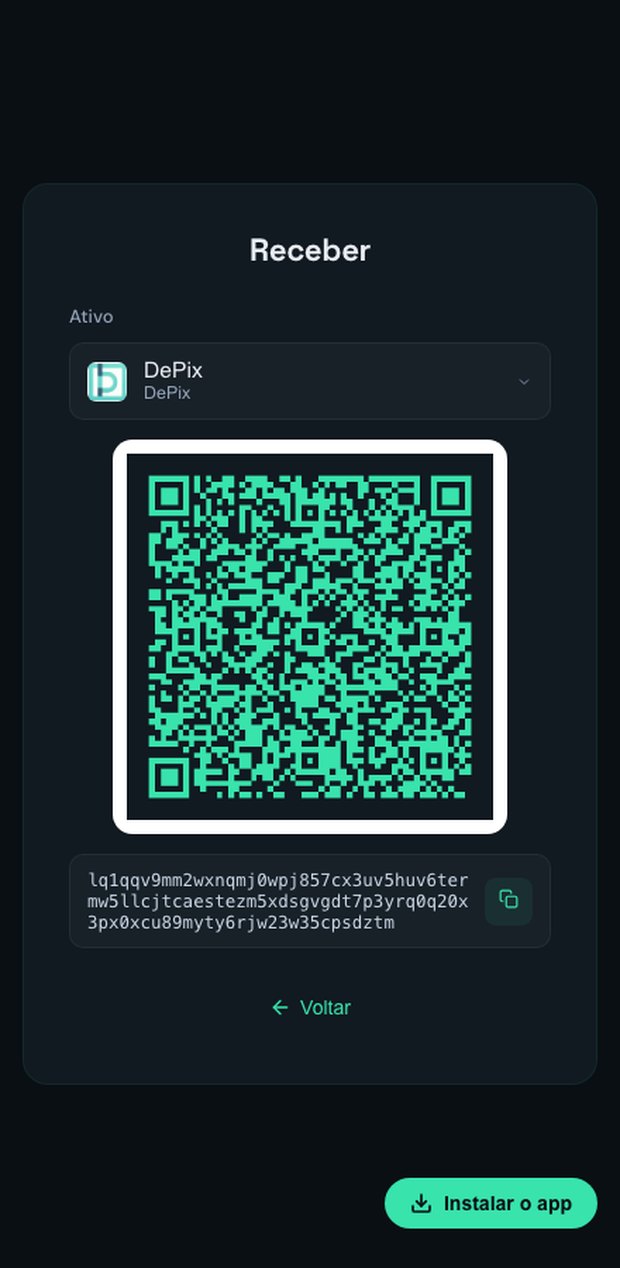
Here’s what it looks like in practice, inside the app:
The responsibilities of being your own bank
Freedom comes with responsibility — and here there’s no middle ground. When you are your own bank, there is no “forgot password”. No manager to call, no support line to reverse a mistake, no “recover account” email button. That’s exactly the price of sovereignty: because nobody holds your keys, nobody can freeze them — but nobody can recover them for you either.
In practice, that means three non-negotiable habits:
- Guard the 12 words with your life. They are the only way to recover the wallet if you lose the device. Write them on paper, store them somewhere safe, and never type the phrase into websites, emails, or messages. Whoever has the 12 words has the money.
- Protect the PIN. In the DePix App, 5 wrong PIN attempts wipe the wallet on that device — a safeguard against unauthorized access. Don’t panic: with the 12 words you restore everything on another device. Without them, the money is truly gone.
- You are your own support desk. A traditional bank’s convenience has a cost (surveillance, freezes, exposure). Self-custody has a different one (guarding the keys is yours alone). Knowing this in advance is what separates people who use the tool well from those who get hurt by it.
If that responsibility sounds heavy, it’s because it’s real. But it’s the same responsibility as keeping cash at home or gold in a safe — with the bonus that you can send it anywhere in the world in minutes.
Sovereignty without leaving legality
Being your own bank has nothing to do with evading taxes. Self-custody and privacy are not synonyms for illegality — they are rights. Just as keeping cash at home doesn’t exempt you from reporting income, holding crypto in self-custody doesn’t put you outside the law. What changes is who guards the money, not your tax obligations.
In most jurisdictions, tax authorities require you to report crypto holdings and gains under specific rules² — in the United States, for instance, the IRS treats virtual currency as property and expects it on your return; Brazil and many other countries have similar regimes. Transaction privacy is one thing; meeting your obligations is another, and the two coexist perfectly. Brazilian readers can dig into the local rules in our guide on how to declare DePix income tax . Real financial sovereignty is the kind you can exercise with your head held high.
And to be clear, no hedging: being your own bank is not what it might sound like. The DePix App is not a bank or a financial institution, it promises no yield, profit, or return, and nothing here is “guaranteed” or “risk-free.” The trade-offs are real — Liquid is a federation (more centralized than Bitcoin), Bitcoin is volatile, and DePix is exposed to the real’s inflation. Knowing these limits is part of using the tools with maturity. Combining privacy, self-custody, and tax honesty is how you exercise sovereignty sustainably — the same principle behind financial privacy with DePix .
References
- Blockstream — Liquid Network: Confidential Transactions
- IRS — Digital assets: virtual currency treated as property
- Bitcoin Whitepaper — Satoshi Nakamoto: peer-to-peer electronic cash
- Banco Central do Brasil — Pix: how it works and its regulation
Your financial sovereignty starts here
A traditional bank has convenience — self-custody has control. Be your own bank: hold your keys, spend DePix privately day to day, and consider Bitcoin for long-term goals, mindful of its volatility, without asking anyone for permission. Start with the integrated wallet at depixapp.com .